
OEUVRE COLORS Urban Art FESTIVAL 2026
RERO Sans titre ( ANTEVASIN…) : L'habitant de la frontière.
Rio - Brazil
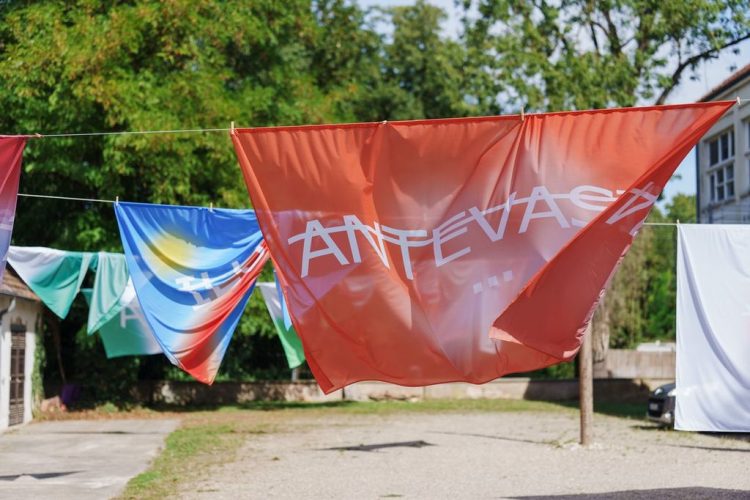
Description de l’oeuvre :
Installation In situ composée de 10 drapeaux géants de 200 x 300 cm chacun, Impression quadri en flou Gaussien 67 ( Numéro du département : Strasbourg) et texte sous rature. 2026
Le travail de RERO repose sur une grammaire visuelle unique : l’utilisation de la police Verdana (symbole de l’ère numérique), systématiquement barrée d’un trait horizontal. Ce geste de rature ne cherche pas l’effacement, mais l’interrogation. L’artiste questionne les rhétoriques de l’image, ainsi que la ‘chaîne flottante des signifiés’ qui s’y combinent.
Punchlines et aphorismes, trahison des images, jeux sémantiques et mises en pièces des nombreuses contradictions de l’époque, le travail de RERO est à la croisée des pratiques urbaines, du land art et des gestes conceptuels.
Punchlines et aphorismes, trahison des images, jeux sémantiques et mises en pièces des nombreuses contradictions de l’époque, le travail de RERO est à la croisée des pratiques urbaines, du land art et des gestes conceptuels.
Intrigantes, lumineuses, riches d’une poésie moderne et transgressive, les oeuvres de RERO sont présentes dans l’espace public, en pleine nature et ont également été présentées au Centre Pompidou, au Cent Quatre, au MAC/VAL, à la Fondation Vasarely, au Grand Palais, à la Fondation Montresso*, au MAC Bogota et actuellement au Petit Palais à Paris.
À l’occasion du COLORS Urban arts Festival de Strasbourg, RERO présente une installation composée de 10 drapeaux géants suspendus sur des cables et sur lesquels on peut lire des mots barrés dans 10 langues différentes et surtout très difficile à traduire mais riche en sens.
« Puisque le mot est inexact, il est barré. Puisqu’il est nécessaire, il reste lisible. »
Gayatri Chakravorty Spivak
Les connexions et les émotions amoureuses
NORVEGE : FORELSKET (Norvégien) : L’étincelle amoureuse. Ce moment précis et vertigineux où l’on commence à tomber amoureux, où le cœur s’emballe et où tout semble magique.
INDE : ONSRA (Boro) : L’amour éphémère. Le sentiment d’aimer quelqu’un avec la certitude douce-amère que cette histoire ne durera pas, ce qui rend chaque seconde cruciale.
CONGO : ILUNGA : Le mot considéré par le Livre Guinness des records comme le « plus difficile à traduire » est Ilunga (de la langue Tshiluba, parlée en République Démocratique du Congo). Il désigne une personne prête à pardonner une première offense, à tolérer une deuxième fois, mais jamais une troisième.
La nostalgie, l’exil et le voyage
HINDOUISME : ANTEVASIN (Sanskrit) : L’habitant de la frontière. Littéralement, celui qui vit à la lisière. C’est une belle métaphore pour désigner une personne en transition spirituelle ou intellectuelle, qui a quitté son passé mais n’est pas encore pleinement ancrée dans son avenir.
PAYS DE GALES : HIRAETH (Gallois) : Le mal du pays irréversible. Une nostalgie poignante pour une terre ou une époque de notre passé qui a changé ou disparu à jamais. C’est le deuil d’un « chez-soi » qui n’existe plus que dans les souvenirs (très proche du concept contemporain d’éco-anxiété ou de solastalgie).
L’existence, l’énergie et la société
NIGERIA : AXÉ (Yoruba/Brésilien) : La force vitale. L’énergie sacrée et cosmique qui anime tout ce qui existe dans l’univers et permet la transformation des choses.
PAPOUASIE – NOUVELLE GUINÉE : MOKITA (Kilivila) : Le secret de Polichinelle. Une vérité évidente, connue de toute une communauté, mais que tout le monde choisit de taire d’un commun accord.
USA : DELULU (Argot Internet/Anglais) : L’illusion volontaire. Le fait de vivre dans le déni ou de s’inventer des scénarios totalement improbables (souvent par choix), soit pour se protéger du réel, soit pour manifester ses désirs à outrance.
La contemplation et le sacré
La contemplation et le sacré
JAPON : YūGEN (Japonais) : La grâce profonde. Un sentiment d’émerveillement et de vertige face à la beauté mystérieuse, subtile et indicible de l’univers (comme regarder un coucher de soleil ou l’immensité de l’océan).
ALSACE : SCHATZALA : Petit trésor . Au-delà de sa traduction, c’est sa phonétique qui fait son charme. Le son « ch » doux du départ, combiné à la légèreté de la fin en « ala », donne au mot une musicalité très affectueuse et chantante, loin des clichés parfois stricts que l’on attribue aux langues germaniques. C’est un mot « doudou » : l’entendre, c’est instantanément se sentir entouré et à la maison. Schàtz : Mon chéri, ma chérie ou mon trésor. Schatzale : Mon petit chéri / mon petit trésor (forme diminutive très usitée en Alsace et à Strasbourg). Schatzala : Il s’agit d’une variante phonétique ou populaire de la prononciation locale, mais la forme exacte avec le diminutif alsacien standard se termine par -le ou -lé. Compliqué ou pas ??
Rero est représenté par la galerie BACKSLASH en Europe.